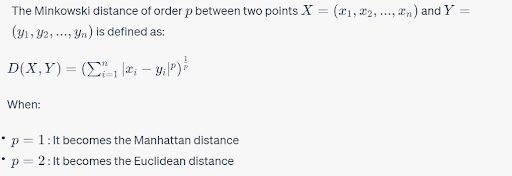
The Minkowski, Manhattan, and Euclidean distances are all ways to measure the distance between points in a space. Let’s dive deeper into each of these.
Minkowski Distance:
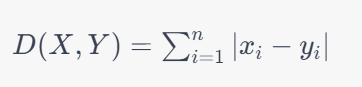
Manhattan Distance (L1 norm):
Also known as the “city block” or “taxicab” distance, it’s the distance between two points in a grid-based path (like Manhattan street grids) and is computed as:
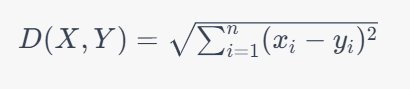
Euclidean Distance (L2 norm):
The most common metric for continuous quantities. It’s the “ordinary” straight-line distance between two points in Euclidean space.
Business Scenarios:
E-commerce Recommendations: If you want to suggest products to a user based on their browsing history, you might use distance metrics to find products that are “close” to what they’ve looked at or purchased in the past.
Real Estate Pricing: When determining the price of a house, you might consider the Euclidean distance to key landmarks or Manhattan distance if you’re considering city blocks to essential facilities like schools, hospitals, etc.
Supply Chain Optimization: If you’re routing delivery trucks, Manhattan distance might be more appropriate in urban settings where you’re constrained by a grid of streets.
Fraud Detection in Banking: By examining transactions in a multi-dimensional space (where dimensions could be amount, frequency, merchant category, etc.), you might identify unusual (i.e., distant from typical) transactions using a distance metric.
Clustering Customers for Market Segmentation: Using clustering algorithms like K-means, which inherently use distance metrics, can help in segmenting customers based on their purchase behaviour, demographic information, etc.
When choosing a distance metric for a business problem, consider the nature of your data and what “distance” would mean contextually. For instance, in a city with a grid-like structure, Manhattan distance might be more representative of actual distances people must travel, while in a more continuous space, Euclidean might be more appropriate.
