Regression, Correlation, and Covariance are related statistical concepts, each serving specific purposes, but they also inform one another.
Regression:
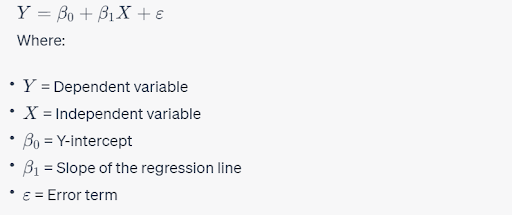
Regression is a statistical analysis used to predict the value of one variable based on the value(s) of one or more other variables. The most common form of regression is linear regression.
Linear Regression Formula (Simple Linear Regression):
Correlation:
Correlation measures the strength and direction of a linear relationship between two variables. It gives a value between -1 and 1.
- A value closer to 1 implies a strong positive correlation: as one variable increases, the other also tends to increase.
- A value closer to -1 implies a strong negative correlation: as one variable increases, the other tends to decrease.
- A value closer to 0 implies little to no linear relationship between the variables.
Pearson Correlation Coefficient Formula:

Covariance:
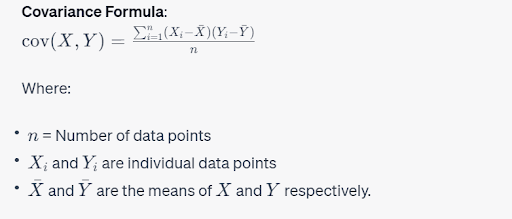
Covariance indicates the direction of the linear relationship between variables.
- Positive covariance: If one variable tends to go up when the other goes up, there is a positive covariance.
- Negative covariance: If one variable tends to go down when the other goes up, there is a negative covariance.
Covariance Formula:
In summary:
Regression is used to predict and model relationships between variables.
Correlation measures the strength and direction of a linear relationship.
Covariance provides a measure of how two variables change together.
